Quick Overview
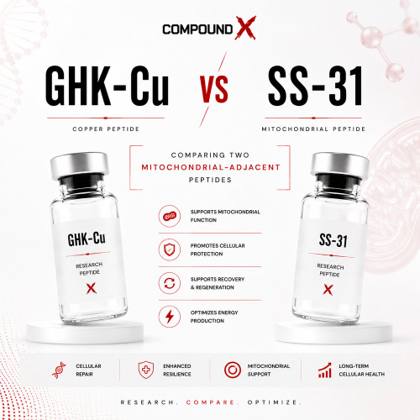
GHK-Cu and SS-31 are both frequently discussed in longevity and anti-aging research contexts, but they work through completely different biological targets — one in skin and connective tissue, the other inside the mitochondria.
GHK-Cu (Copper Peptide)
A naturally occurring copper-binding tripeptide found in human plasma, saliva and urine. Circulating levels decline with age.
SS-31 (Elamipretide)
A synthetic, mitochondria-targeted tetrapeptide developed by Hazel Szeto and Peter Schiller. Has progressed through multiple human clinical trials.
Mechanism Compared
GHK-Cu is studied for its ability to bind copper and activate gene-expression pathways associated with collagen and elastin synthesis, antioxidant enzyme activity, and anti-inflammatory signaling in dermal and connective tissue — a mechanism centered on tissue remodeling and skin biology. SS-31 works through an entirely different, more specialized mechanism: it selectively binds cardiolipin, a phospholipid unique to the inner mitochondrial membrane, where it's studied for stabilizing mitochondrial cristae structure and improving electron-transport-chain efficiency — a distinct pathway from peptides acting at cell-surface receptors.
Clinical Trial History Compared
This is where the two diverge most. SS-31 is among the more clinically advanced compounds in this entire category, having progressed through multiple human clinical trials for mitochondrial disease, giving it published human safety data from actual trial programs. GHK-Cu has a long history of topical cosmetic use, but its injectable/research use specifically has not been evaluated in large controlled human trials — its evidence base leans more heavily on in-vitro and animal gene-expression studies for the systemic research applications discussed in research communities.
Dosing Guide
What the research shows
Neither has an FDA-approved dosage for general use. SS-31 has trial-specific dosing from its mitochondrial disease research programs, but that data is tied to regulated trials, not a public human protocol. GHK-Cu research doses vary widely by study design and are not standardized.
Compound X does not provide dosing recommendations. Both peptides are sold for laboratory research use only and are not intended for human consumption.
Side Effects Compared
As a clinically trialed compound, SS-31/Elamipretide has published human safety data from its trial programs, including reports of injection-site reactions — though it has not received full FDA approval for a marketed indication, and research-grade material outside those regulated trials hasn't undergone the same oversight. GHK-Cu's reported concerns include local irritation at injection sites and, at high concentrations, potential pro-oxidant effects reported in some in-vitro models — a notable caution given its antioxidant reputation at typical concentrations.
The Verdict
SS-31 has the stronger clinical trial pedigree; GHK-Cu has the longer track record
If the priority is human clinical trial evidence, SS-31 is the more advanced compound, having actually been through mitochondrial disease trials. GHK-Cu's strength is a long history of topical cosmetic use and a well-characterized gene-expression mechanism, but its systemic research use hasn't been through the same level of controlled human testing.
FAQ
Has SS-31 been approved by the FDA?
No. Despite progressing through multiple human clinical trials for mitochondrial disease, SS-31 (Elamipretide) has not received full FDA approval for a marketed indication.
Is GHK-Cu safe?
It has a long history of topical cosmetic use with a generally favorable profile at typical concentrations, though injectable/research use hasn't been evaluated in large controlled human trials, and high concentrations have shown potential pro-oxidant effects in some in-vitro models.
Which peptide has more human research, GHK-Cu or SS-31?
SS-31 has the more advanced human clinical trial history, having been studied in actual mitochondrial disease trial programs. GHK-Cu's systemic research use relies more on in-vitro and animal gene-expression data.
References
GHK-Cu gene-expression and tissue-remodeling mechanism literature. SS-31/Elamipretide cardiolipin-binding mechanism and mitochondrial disease clinical trial program, Szeto HH & Schiller PW.