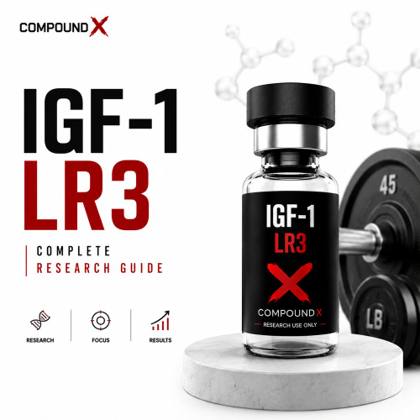
What Is IGF-1 LR3?
IGF-1 LR3 (Long Arg3-IGF-1) is a synthetic, modified analog of endogenous Insulin-like Growth Factor-1, engineered with an extended amino-acid sequence and substitution at the third residue that reduces its binding to IGF-binding proteins.
Mechanism of Action
By reducing affinity for IGF-binding proteins, IGF-1 LR3 remains more bioavailable to IGF-1 receptors than native IGF-1 in experimental systems, a property researchers have used to study amplified downstream growth-signaling effects compared to unmodified IGF-1.
Studied Benefits
These are effects IGF-1 LR3 has been studied for in available preclinical and early research — not claims about guaranteed outcomes.
🧬
Growth-Signaling Research
IGF-1 receptor activation is strongly associated with cellular growth and protein-synthesis pathways, and IGF-1 LR3's extended bioavailability has made it a common tool in cell-growth and hypertrophy-signaling research.
⚡
IGF-Receptor Research
Because IGF-1 LR3's altered binding-protein interaction distinguishes it from native IGF-1, it is frequently used in research examining how free versus bound IGF-1 differentially activates receptor signaling.
Dosing Guide
What the research shows
Doses used in cell-culture and animal research vary by study design and are not established as a human protocol. No FDA-approved human dosage exists for IGF-1 LR3.
Compound X does not provide dosing recommendations. IGF-1 LR3 is sold for laboratory research use only and is not intended for human consumption.
Reported Side Effects
IGF-1 LR3 is not FDA-approved and has not been evaluated in controlled human trials. Reported concerns associated with excess IGF-1 signaling in the broader endocrine literature include hypoglycemia risk, fluid retention, and theoretical concerns about unchecked cell proliferation, none of which have been systematically studied for this specific analog in humans.
FAQ
Is IGF-1 LR3 FDA-approved?
No. IGF-1 LR3 is not FDA-approved for any indication and is sold strictly as a research chemical, not a medication or dietary supplement.
What is IGF-1 LR3 commonly studied for?
Growth-Signaling Research — IGF-1 receptor activation is strongly associated with cellular growth and protein-synthesis pathways, and IGF-1 LR3's extended bioavailability has made it a common tool in cell-growth and hypertrophy-signaling research.
Is IGF-1 LR3 legal to buy in the US?
In the US, UK, Canada and Australia, IGF-1 LR3 is generally sold labeled "for research use only, not for human consumption." It is not approved as a dietary supplement or medication in any of these countries.
References
IGF-1 LR3 research is indexed on PubMed under search terms such as "Long R3 IGF-1" and "IGF-1 analog receptor binding protein."