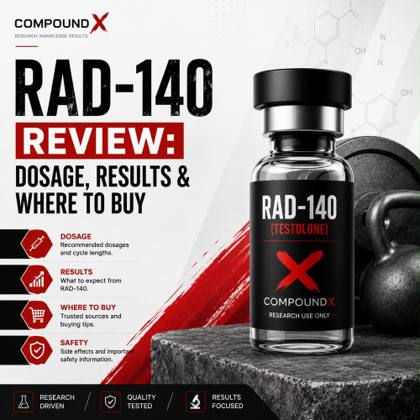
What Is RAD-140?
RAD-140 (Testolone) is a nonsteroidal selective androgen receptor modulator (SARM) originally developed by Radius Health. It was designed to bind the androgen receptor with tissue selectivity — activating anabolic pathways in muscle and bone while limiting activity in reproductive tissue, unlike testosterone or traditional anabolic steroids. The compound later moved into oncology research and is now developed under the name Vosilasarm by Ellipses Pharmaceuticals for estrogen-receptor-positive, HER2-negative metastatic breast cancer.
Mechanism of Action
RAD-140 binds the androgen receptor (AR) with high affinity. Preclinical studies found it produced anabolic signaling in muscle and bone tissue at levels comparable to testosterone, while showing reduced stimulation of the prostate and other androgen-sensitive reproductive tissue — the tissue-selectivity premise that defines SARMs as a drug class. In AR-positive breast cancer models, RAD-140 was also studied for its ability to activate the androgen receptor as a growth-inhibitory pathway, since AR activation can oppose estrogen-driven tumor growth in some receptor-positive cancers.
Clinical Trial Data
Unlike most SARMs discussed online, RAD-140 has real human trial data — because it has been studied as an oncology drug candidate, not a bodybuilding supplement.
Phase 1 Trial — ER+/HER2- Metastatic Breast Cancer
A first-in-human Phase 1 dose-escalation study evaluated RAD-140 in postmenopausal women with advanced ER+/HER2- metastatic breast cancer. At the maximum tolerated dose of 100 mg/day, the trial reported a clinical benefit rate of 18.2% at 24 weeks, including one confirmed partial response. This is oncology-population data in late-stage, heavily pre-treated patients — not evidence about outcomes in healthy individuals.
This trial is the primary source of controlled human safety and pharmacokinetic data on RAD-140, and it is why RAD-140's known side-effect profile (below) is unusually well-documented compared to most unapproved SARMs, most of which have only rodent data.
Studied Benefits
These are effects RAD-140 has been studied for in preclinical and early clinical research — not claims about guaranteed outcomes in humans.
💪
Tissue-Selective Anabolic Signaling
Preclinical rodent and in-vitro work found anabolic activity in muscle and bone with reduced reproductive-tissue stimulation vs testosterone.
🎗️
AR-Positive Oncology Research
Studied as a growth-inhibitory pathway in estrogen-receptor-positive breast cancer, now advancing as Vosilasarm.
💊
Oral Route
Administered orally in the Phase 1 trial — no reconstitution or injection, unlike many peptides on this site.
🔬
Well-Characterized Receptor Selectivity
One of the more thoroughly profiled SARMs for AR binding affinity and tissue selectivity in the preclinical literature.
Dosing Guide
What the trial data actually shows
These figures are reported strictly as clinical trial data — not a recommendation. RAD-140 is not FDA-approved and has no established human dosage outside a controlled trial setting.
| Context | Dose Tested | Source |
|---|
| Phase 1 oncology trial (MTD) | 100 mg/day, oral, under clinical supervision | First-in-human Phase 1 study, ER+/HER2- metastatic breast cancer |
| Preclinical rodent studies | Varies — scaled to body weight (mg/kg) | Multiple in-vitro/in-vivo pharmacology papers |
Compound X does not provide dosing recommendations. RAD-140 is sold for laboratory research use only and is not intended for human consumption.
Reported Side Effects
The Phase 1 trial's safety data gives a clearer picture than the rodent-only data available for most SARMs. Reported adverse events included:
- Elevated liver enzymes (AST/ALT)
- Hyperbilirubinemia
- Hypophosphatemia
- Vomiting, dehydration and weight loss
Grade 3/4 (severe) adverse events occurred in up to 72.7% of trial participants at higher doses — a meaningfully high rate, though this was measured in an oncology population already affected by advanced cancer and prior treatment, not in healthy adults.
Legal Status & WADA
RAD-140 is not FDA-approved for any indication and remains an investigational compound. It is included on the World Anti-Doping Agency's (WADA) Prohibited List under the SARMs category, meaning its use is banned in any WADA-regulated competitive sport, in and out of competition.
FAQ
Is RAD-140 the same as a steroid?
No. RAD-140 is a nonsteroidal SARM — it binds the same androgen receptor as testosterone and anabolic steroids but has a different chemical structure and was designed for tissue-selective activity.
Has RAD-140 been tested in healthy people?
Not in a published controlled trial. The only human trial data available comes from a Phase 1 oncology study in postmenopausal women with advanced breast cancer, not from healthy volunteers or an athletic population.
Is RAD-140 legal to buy in the US?
Regulatory status varies by country. In the US, UK, Canada and Australia it is generally sold labeled "for research use only, not for human consumption." It is not approved as a dietary supplement or medication anywhere, and is banned under WADA rules for competitive athletes.
References
Sources referenced in this guide: the first-in-human Phase 1 study of RAD140 in ER+/HER2- metastatic breast cancer; RAD-140 development history under Radius Health and continuation as Vosilasarm under Ellipses Pharmaceuticals; World Anti-Doping Agency Prohibited List, SARMs category. RAD-140 research is indexed on PubMed under "RAD140 Testolone SARM" and "selective androgen receptor modulator RAD-140."