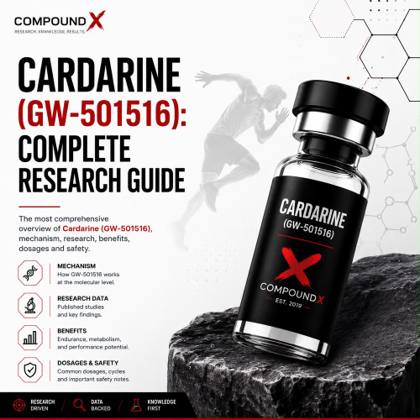
What Is Cardarine (GW-501516)?
Cardarine (GW-501516) is a synthetic PPAR-delta (PPARδ) receptor agonist originally developed by GlaxoSmithKline and Ligand Pharmaceuticals in the 1990s-2000s for research into metabolic conditions such as dyslipidemia and obesity. It is not a SARM despite frequently being marketed alongside them, since it does not act on the androgen receptor at all.
Mechanism of Action
Cardarine activates PPAR-delta, a nuclear receptor that regulates genes involved in fatty-acid metabolism and energy expenditure, shifting cellular metabolism toward fat oxidation — the mechanism behind its research interest in endurance and metabolic contexts.
Studied Benefits
These are effects Cardarine (GW-501516) has been studied for in available preclinical and early research — not claims about guaranteed outcomes.
🧬
Endurance & Metabolic Research
Preclinical studies found that Cardarine increased fat oxidation and endurance capacity in animal models, and it was originally studied by its developers specifically for metabolic syndrome and dyslipidemia before that program was discontinued.
⚡
Regulatory & Safety History
The original GSK/Ligand clinical development program for Cardarine was discontinued after long-term carcinogenicity studies in animals showed rapid-onset cancers across multiple organs at exposure levels relevant to the studied doses — a well-documented reason the compound never advanced to human approval and remains a significant safety consideration in any Cardarine research discussion.
Dosing Guide
What the research shows
No FDA-approved or clinically validated human dosage exists for Cardarine. Doses referenced in early-stage human trials before program discontinuation are documented in that limited trial literature but do not constitute an established protocol.
Compound X does not provide dosing recommendations. Cardarine (GW-501516) is sold for laboratory research use only and is not intended for human consumption.
Reported Side Effects
Because of the carcinogenicity findings that ended its original development program, Cardarine carries a materially different risk profile from other research compounds in this category. It has never been approved for human use, has no established human safety data from completed trials, and is banned by the World Anti-Doping Agency.
FAQ
Is Cardarine (GW-501516) FDA-approved?
No. Cardarine (GW-501516) is not FDA-approved for any indication and is sold strictly as a research chemical, not a medication or dietary supplement.
What is Cardarine (GW-501516) commonly studied for?
Endurance & Metabolic Research — Preclinical studies found that Cardarine increased fat oxidation and endurance capacity in animal models, and it was originally studied by its developers specifically for metabolic syndrome and dyslipidemia before that program was discontinued.
Is Cardarine (GW-501516) legal to buy in the US?
In the US, UK, Canada and Australia, Cardarine (GW-501516) is generally sold labeled "for research use only, not for human consumption." It is not approved as a dietary supplement or medication in any of these countries.
References
Cardarine's preclinical and toxicology findings are indexed on PubMed under "GW501516 PPAR delta carcinogenicity" and "Cardarine GW-501516 metabolic."