Quick Overview
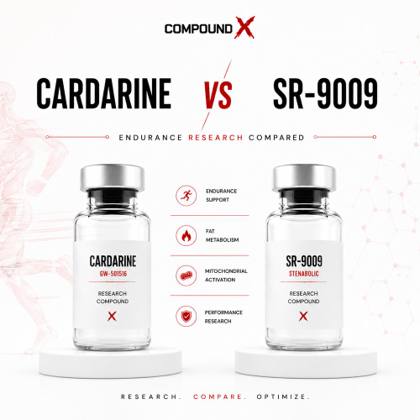
Cardarine and SR-9009 are both frequently marketed as "SARMs" for endurance and fat-loss research, despite neither actually being a SARM. Both have real, documented problems that rarely make it into typical comparison content — one regulatory, one pharmacokinetic.
Cardarine (GW-501516)
A PPARδ agonist co-developed by Ligand Pharmaceuticals and GlaxoSmithKline. Discontinued in 2007 after rodent carcinogenicity findings.
SR-9009 (Stenabolic)
A REV-ErbA agonist developed at Scripps Research. Original research used injection, not oral dosing, due to poor absorption.
Mechanism Compared
Cardarine activates PPARδ (peroxisome proliferator-activated receptor delta), a nuclear receptor involved in fatty-acid metabolism and studied for shifting cellular energy preference toward fat oxidation — the basis for its endurance-research reputation. SR-9009 activates REV-ErbA, a different nuclear receptor central to the molecular circadian clock, which also regulates genes involved in lipid metabolism, mitochondrial biogenesis and inflammatory pathways. Neither interacts with the androgen receptor — both are commonly mislabeled as SARMs simply because they're sold alongside them.
Cardarine's Real History
GW-501516 actually made it into real early-phase human trials under GlaxoSmithKline — two Phase 1 studies and one Phase 2 study, showing favorable early effects on HDL cholesterol and triglycerides. GSK abandoned clinical development in 2006-2007 after preclinical toxicology studies in rodents found the compound potentiated tumor growth across multiple organs (liver, bladder, ovaries, testes) in long-term exposure studies, notably in the Apc(min) mouse model of intestinal cancer. It was never approved for human use, and WADA issued a direct public safety alert in 2013 after learning athletes were sourcing it on the black market.
SR-9009's Bioavailability Problem
SR-9009 has an issue that's rarely disclosed by vendors selling oral capsules: the compound's original characterization study (Solt et al., 2012, Nature) used twice-daily intraperitoneal (injection) dosing in mice — not oral administration — specifically because oral bioavailability is extremely poor. Published pharmacology from the same research group reports oral absorption around 2.2%, versus 100% via injection. This means most orally-sold SR-9009 products may not replicate the exposure levels used in the foundational research at all — a significant, underdiscussed limitation.
Dosing Guide
Why dosing is especially unclear for these two
Neither compound has a human dosing protocol. Cardarine's human data comes from GSK's terminated trial program (doses not consistently public), and SR-9009 has no completed human trials at all — its research-relevant dosing used injection, not the oral route most vendors sell.
Compound X does not provide dosing recommendations. Both compounds are sold for laboratory research use only and are not intended for human consumption.
The Verdict
Both carry real, specific red flags
Cardarine's flag is the more serious one: a documented carcinogenicity signal that ended a real pharmaceutical development program. SR-9009's flag is different — a practical one, where the oral products commonly sold may not deliver meaningful exposure relative to the injection-based research that established its effects in the first place.
FAQ
Why was Cardarine discontinued by GSK?
Preclinical toxicology studies in rodents found it potentiated tumor growth across multiple organs, most notably in the Apc(min) mouse intestinal cancer model. GSK ended clinical development in 2006-2007.
Does oral SR-9009 actually work the way the research suggests?
That's genuinely unclear. The foundational Solt et al. 2012 study used injection specifically because oral bioavailability in rodents is reported around 2.2% — most commercially sold oral SR-9009 products haven't demonstrated they replicate that research exposure.
Are Cardarine and SR-9009 SARMs?
No. Cardarine is a PPARδ agonist and SR-9009 is a REV-ErbA agonist — neither interacts with the androgen receptor, despite commonly being sold in the same category as SARMs.
References
GW501516 development history, Ligand Pharmaceuticals/GlaxoSmithKline; WADA public safety alert, 2013. Solt LA, et al. Nature. 2012 (SR9009/SR9011 REV-ErbA agonist characterization, i.p. dosing). Burris lab pharmacokinetic data on SR9009 oral bioavailability.