Quick Overview
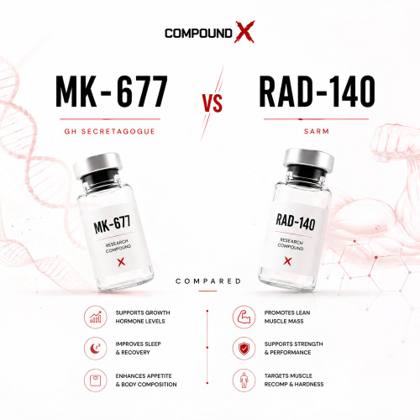
MK-677 (Ibutamoren) and RAD-140 (Testolone) are both sold in the same "SARMs" category on most vendor sites, including this one — but that's a commercial grouping, not a mechanistic one. Only RAD-140 is actually a selective androgen receptor modulator. Understanding that distinction is the key to this comparison.
MK-677 (Ibutamoren)
An orally active, non-peptide growth hormone secretagogue. Activates the ghrelin receptor — has nothing to do with the androgen receptor.
RAD-140 (Testolone)
A genuine nonsteroidal SARM, binding the androgen receptor with tissue-selective activity.
Mechanism Compared — Why MK-677 Isn't a SARM
MK-677 activates the ghrelin receptor (GHS-R1a), stimulating pulsatile growth hormone release from the pituitary and, downstream, raising IGF-1 levels. It never touches the androgen receptor. RAD-140, by contrast, binds the androgen receptor (AR) directly with high affinity, and was designed for tissue-selective anabolic activity — the actual defining mechanism of the SARM drug class. The two compounds are commonly grouped together commercially because they're both popular in bodybuilding-adjacent research circles, but they act on entirely separate hormonal systems.
The Trial Data, Side by Side
MK-677 — Nass et al., 2008
A 2-year, double-blind, randomized, placebo-controlled trial in 65 healthy older adults (ages 60-81), dosed at 25mg/day orally. Restored GH/IGF-1 to young-adult levels; fat-free mass increased 1.1kg vs a 0.5kg decrease with placebo (p<0.001).
RAD-140 — Phase 1 Oncology Trial
Postmenopausal women with advanced ER+/HER2- metastatic breast cancer. At 100mg/day (MTD): 18.2% clinical benefit rate at 24 weeks. Grade 3/4 adverse events in up to 72.7% of participants at higher doses.
MK-677's trial is the longer and more directly relevant one for a general research population — 2 years, healthy older adults, body-composition and hormonal endpoints. RAD-140's trial, while real and rigorous, was conducted in a very different population (advanced cancer patients) for a very different endpoint (tumor response).
Dosing Guide
What each trial actually tested
| Compound | Dose Tested | Trial Population |
|---|
| MK-677 | 25 mg/day, oral, 2 years | 65 healthy adults, ages 60-81 |
| RAD-140 | Up to 100 mg/day (MTD) | Postmenopausal women, advanced breast cancer |
Compound X does not provide dosing recommendations. Neither compound is FDA-approved for general use, and both are sold for laboratory research use only.
Side Effects Compared
MK-677's 2-year trial found consistently replicated effects: fasting glucose +0.3mmol/L, reduced insulin sensitivity, increased appetite, mild fluid retention and muscle pain. RAD-140's oncology trial reported more severe findings — elevated liver enzymes, hyperbilirubinemia, hypophosphatemia, vomiting, dehydration and weight loss, with Grade 3/4 events in up to 72.7% of participants — though that severity is measured in an already-ill cancer population, not healthy adults.
The Verdict
Not really comparable — and that's the actual insight
MK-677 and RAD-140 aren't interchangeable options for the same goal. One is a GH-axis compound with real long-term human data in a general-health context; the other is a genuine androgen-receptor SARM with real but narrowly-scoped oncology trial data. The commercial habit of grouping them together as "SARMs" obscures a real mechanistic difference worth understanding before comparing anything else about them.
FAQ
Is MK-677 a SARM?
No. Despite being sold alongside SARMs, MK-677 is a growth hormone secretagogue that acts on the ghrelin receptor — it has no activity at the androgen receptor at all.
Which has more human safety data, MK-677 or RAD-140?
MK-677 has a longer, more general-population trial (2 years, 65 healthy older adults). RAD-140's human data comes from a Phase 1 oncology trial in a narrower, already-ill population.
Is either legal to buy in the US?
Neither is FDA-approved. Both are sold labeled "for research use only, not for human consumption." RAD-140 is explicitly WADA-banned under the SARMs category.
References
Nass R, Pezzoli SS, Oliveri MC, et al. Annals of Internal Medicine. 2008;149(9):601-611. First-in-human Phase 1 study of RAD140 in ER+/HER2- metastatic breast cancer.