Quick Overview
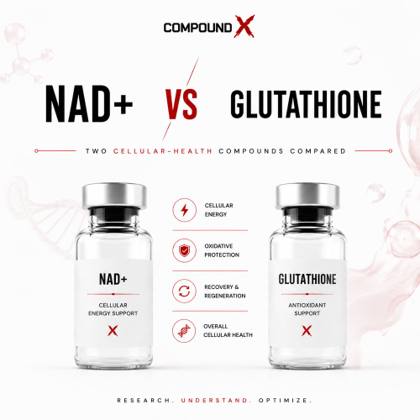
NAD+ and Glutathione are both naturally occurring molecules present in every cell of the body, both central to current longevity and cellular-health research, and both frequently discussed in the same conversations about aging. But they play very different biological roles.
NAD+
A coenzyme central to mitochondrial ATP production and a substrate for sirtuins and PARP enzymes involved in DNA repair.
Glutathione
A tripeptide (glutamate, cysteine, glycine) that serves as the body's primary intracellular antioxidant and a key player in liver detoxification.
Mechanism Compared
NAD+ (Nicotinamide Adenine Dinucleotide) functions as an essential cofactor in mitochondrial ATP production and serves as a substrate for sirtuins and PARP enzymes — pathways central to current aging-biology research, since NAD+ levels are known to decline with age. Glutathione neutralizes reactive oxygen species directly and serves as a cofactor for glutathione peroxidase, a central antioxidant-defense enzyme, while also playing a role in Phase II liver detoxification by conjugating with toxins and heavy metals to facilitate their excretion. NAD+'s research angle is primarily energy metabolism and DNA repair; Glutathione's is primarily oxidative-stress defense and detoxification.
What Human Data Exists
For NAD+, most human clinical trial data actually studies its precursors — NMN and NR (nicotinamide mononucleotide and riboside) — rather than direct NAD+ administration itself, which is comparatively under-studied in controlled human trials. Glutathione, by contrast, occurs so ubiquitously in normal human biology that its general safety profile is well characterized in studied contexts — though a popular off-label application (IV/injectable glutathione for cosmetic skin-lightening) has not been evaluated for long-term safety by the FDA and has generated its own case-report safety literature.
Dosing Guide
What the research shows
Neither compound has an FDA-approved dosage as a research chemical. Direct NAD+ administration research (as opposed to precursor research) is comparatively limited in humans; Glutathione dosing varies widely across its different studied contexts (oral, IV, injectable) without a single standardized research protocol.
Compound X does not provide dosing recommendations. Both compounds are sold for laboratory research use only and are not intended for human consumption.
Side Effects Compared
Reported concerns with NAD+ infusions include injection-site or infusion-related discomfort and flushing; comprehensive long-term human safety data for direct NAD+ administration remains limited. Glutathione has a favorable general safety profile in studied contexts given its natural presence in the body, though the specific off-label cosmetic IV use has been associated in some case reports with adverse effects not evaluated for long-term safety by the FDA.
The Verdict
Different tools for different research questions
NAD+ is the stronger choice for energy-metabolism and DNA-repair-focused research interest, though most of its rigorous human data actually comes from precursor studies (NMN/NR), not NAD+ itself. Glutathione has a longer natural-biology track record and is the more relevant compound for oxidative-stress and detoxification research specifically.
FAQ
Is NAD+ the same as NMN or NR?
No. NAD+ is the coenzyme itself; NMN and NR are precursor molecules the body converts into NAD+. Most human clinical trial data studies the precursors, not direct NAD+ administration.
Is Glutathione safe?
It's naturally present in every cell and has a generally favorable safety profile in studied contexts. The specific off-label use for cosmetic skin-lightening via IV/injection has not been evaluated for long-term safety by the FDA and carries its own reported concerns.
Which is better for anti-aging research, NAD+ or Glutathione?
They address different mechanisms of aging — NAD+ for energy metabolism and DNA repair, Glutathione for oxidative stress and detoxification. Neither has robust direct-administration human trial data confirming anti-aging claims.
References
NAD+/sirtuin and PARP pathway research as characterized in aging-biology literature. NMN/NR precursor clinical trial data. Glutathione Phase II liver detoxification and antioxidant-defense mechanism literature.