Quick Overview
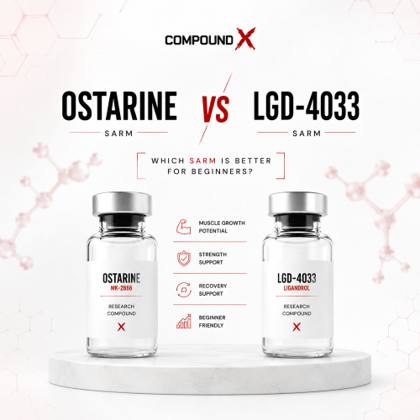
Ostarine (also known as enobosarm or GTx-024) and LGD-4033 are two of the most frequently recommended "beginner" SARMs in online research communities. What's rarely mentioned is that Ostarine has actually progressed further through the human clinical trial pipeline than almost any other SARM discussed on this site — including reaching Phase 3.
Ostarine (Enobosarm)
Developed by GTx Inc. Progressed through Phase 2 and Phase 3 human trials for cancer-related muscle wasting.
LGD-4033 (Ligandrol)
Developed by Ligand Pharmaceuticals. Has a real Phase 1 RCT in healthy young men (Basaria 2013).
Mechanism Compared
Both are nonsteroidal SARMs designed for tissue-selective androgen receptor activation — targeting muscle and bone anabolic activity while limiting effects on the prostate and other reproductive tissue relative to testosterone. The core SARM mechanism is shared; the meaningful difference between them is how far each has actually been tested in humans and for what purpose.
The Trial Data, Side by Side
Ostarine — Phase 2 and Phase 3 (POWER) Trials
A Phase 2 trial in cancer cachexia showed increased lean body mass and improved stair-climb power/speed. The subsequent Phase 3 POWER trials — in stage 3/4 non-small-cell lung cancer patients — failed to meet their primary endpoints for lean body mass and physical function, despite the earlier Phase 2 promise.
LGD-4033 — Basaria et al., 2013
76 healthy young men, randomized, double-blind, placebo-controlled, 21 days. Dose-dependent lean mass gains up to +1.21kg at 1.0mg/day, alongside suppressed SHBG, testosterone and HDL cholesterol.
This is a genuinely interesting contrast: Ostarine has been tested further down the drug-development pipeline (Phase 3) but in a sicker, more complex patient population where its Phase 3 results ultimately disappointed. LGD-4033's data is earlier-stage (Phase 1) but was collected in healthy young men with a clear positive dose-response — arguably more directly relevant to how it's actually used in research communities, even though it's a smaller, shorter, less advanced trial overall.
Dosing Guide
What each trial actually tested
| Compound | Dose Tested | Trial Population |
|---|
| Ostarine | Varied by trial phase | Elderly adults (Phase 2); NSCLC cachexia patients (Phase 3) |
| LGD-4033 | 0.1 / 0.3 / 1.0 mg/day, 21 days | 76 healthy young men |
Compound X does not provide dosing recommendations. Neither compound is FDA-approved for any indication, and both are sold for laboratory research use only.
Side Effects Compared
Ostarine's trial program, having progressed furthest through development, has generated more published safety commentary than most SARMs — including ongoing debate in the literature (see Lambert et al., 2021, Journal of Cachexia, Sarcopenia and Muscle) about whether the FDA's efficacy criteria for cachexia drugs were appropriate for judging it. LGD-4033's 21-day trial reported dose-dependent SHBG, testosterone and HDL suppression, alongside being otherwise described as well tolerated over that short window.
The Verdict
Neither is "safer" by default — they've just been tested differently
Ostarine has the more extensive trial history (Phase 2 and 3), but its Phase 3 results were disappointing in the specific population studied. LGD-4033 has a smaller but positive Phase 1 result in healthy men. Neither outcome should be read as a blanket safety verdict — both remain unapproved, WADA-banned research compounds regardless of trial stage.
FAQ
Has Ostarine really been through Phase 3 trials?
Yes — the POWER trials were Phase 3 studies of enobosarm (Ostarine) in non-small-cell lung cancer patients with muscle wasting, though they ultimately failed to meet their primary efficacy endpoints.
Does more trial data mean Ostarine is safer than LGD-4033?
Not necessarily. More trial data means more is known, but Ostarine's furthest trials were in a sick patient population studying a specific cachexia endpoint — not a direct safety comparison to LGD-4033's healthy-population trial.
Are Ostarine and LGD-4033 legal to buy in the US?
Neither is FDA-approved. Both are sold labeled "for research use only, not for human consumption" and are banned under WADA's SARMs category.
References
Dalton JT, et al. Journal of Cachexia, Sarcopenia and Muscle. 2011 (Phase 2 enobosarm trial). POWER trials (Phase 3), enobosarm in NSCLC cachexia. Lambert CP, et al. J Cachexia Sarcopenia Muscle. 2021. Basaria S, et al. Journals of Gerontology: Series A. 2013;68(1):87-95.