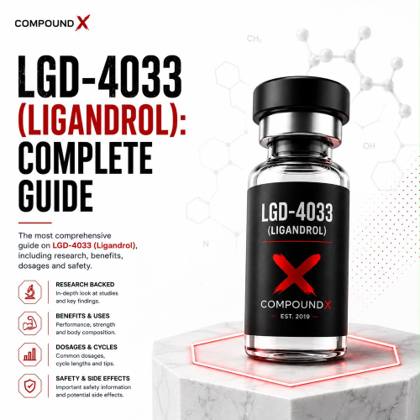
What Is LGD-4033?
LGD-4033 (Ligandrol) is a nonsteroidal, orally bioavailable selective androgen receptor modulator (SARM) originally developed by Ligand Pharmaceuticals. It's one of the most-studied SARMs in the research community, largely because — unlike many SARMs sold online — it has real, published, placebo-controlled human trial data.
Mechanism of Action
Like other SARMs, LGD-4033 binds the androgen receptor with high affinity and is designed for tissue-selective anabolic activity — targeting muscle and bone while minimizing stimulation of the prostate and other androgen-sensitive tissue compared to testosterone. Its long elimination half-life (reported around 24–36 hours in the trial below) supports once-daily oral dosing in research settings, distinguishing it pharmacokinetically from shorter-acting SARMs.
The Basaria 2013 Trial
Basaria et al., 2013 — Journals of Gerontology: Series A
"The safety, pharmacokinetics, and effects of LGD-4033, a novel nonsteroidal oral, selective androgen receptor modulator, in healthy young men" was a randomized, double-blind, placebo-controlled, ascending-dose study in 76 healthy young men, dosed once daily for 21 days at 0.1 mg, 0.3 mg or 1.0 mg — one of the most rigorous human SARM trials published to date.
The trial found a clear dose-response relationship in lean body mass: +0.2 kg at 0.1 mg/day, +0.6 kg at 0.3 mg/day, and +1.21 kg at 1.0 mg/day, all over just 21 days. The same trial reported that LGD-4033 was generally well tolerated with no significant clinical safety signals over the study period, alongside the hormonal suppression covered below.
Studied Benefits
📈
Dose-Dependent Lean Mass Gain
Up to +1.21 kg lean body mass at the highest dose tested, over just 21 days, in a controlled RCT.
💊
Oral, Once-Daily Dosing
Long elimination half-life supported a simple once-daily oral protocol in the trial.
🔬
Real Human Safety Data
One of the few SARMs with a genuine placebo-controlled human trial rather than rodent-only data.
🎯
Tissue-Selective Design
Engineered for reduced reproductive-tissue stimulation relative to testosterone, the core SARM research premise.
Dosing Guide
What the Basaria 2013 trial tested
These figures are reported strictly as clinical trial data — not usage guidance. LGD-4033 is not FDA-approved and has no established human dosage outside a controlled trial setting.
| Dose (21-day trial) | Lean Mass Change | Notes |
|---|
| 0.1 mg/day | +0.2 kg | Lowest dose arm |
| 0.3 mg/day | +0.6 kg | Mid dose arm |
| 1.0 mg/day | +1.21 kg | Highest dose arm — also largest hormonal suppression |
Compound X does not provide dosing recommendations. LGD-4033 is sold for laboratory research use only and is not intended for human consumption.
Reported Side Effects
The Basaria 2013 trial found LGD-4033 suppressed sex hormone-binding globulin (SHBG), total testosterone and HDL ("good") cholesterol in a dose-dependent manner — meaningful hormonal and lipid changes even over a short 21-day period. Longer-term human safety data beyond this trial window does not exist in the published literature.
Legal Status & WADA
LGD-4033 is not FDA-approved for any indication. It is included on the World Anti-Doping Agency's (WADA) Prohibited List under the SARMs category, the same classification as RAD-140, and is banned in WADA-regulated competitive sport at all times.
FAQ
How is LGD-4033 different from RAD-140?
Both are nonsteroidal SARMs, but LGD-4033 has a published 76-man, placebo-controlled trial in healthy young men, while RAD-140's only human data comes from an oncology trial in breast cancer patients. Their receptor-binding and selectivity profiles also differ.
Did the Basaria trial find any safety concerns?
Yes — dose-dependent suppression of SHBG, total testosterone and HDL cholesterol, even over just 21 days. The trial reported it was otherwise well tolerated in that short window.
Is LGD-4033 legal to buy in the US?
It is sold labeled "for research use only, not for human consumption" and is not approved as a dietary supplement or medication. It is banned under WADA rules for competitive athletes.
References
Basaria S, Collins L, Dillon EL, et al. "The safety, pharmacokinetics, and effects of LGD-4033, a novel nonsteroidal oral, selective androgen receptor modulator, in healthy young men." Journals of Gerontology: Series A. 2013;68(1):87-95. World Anti-Doping Agency Prohibited List, SARMs category.