What Is Post-Cycle Therapy?
Post-Cycle Therapy (PCT) refers to a recovery period and set of practices discussed in the research community after a cycle of exogenous anabolic-androgenic compounds or SARMs, aimed at helping the body's own hormone production return to baseline. It is not a single product — it's a recovery concept built around monitoring and supporting the hypothalamic-pituitary-testicular axis (HPTA).
Why Suppression Happens
The HPTA operates on a negative feedback loop: the hypothalamus releases GnRH, which signals the pituitary to release LH and FSH, which in turn signal the testes to produce testosterone. When exogenous androgens or SARMs are introduced, the hypothalamus and pituitary sense elevated androgen activity and reduce their own GnRH/LH/FSH output — which, over time, can reduce natural testosterone production. This suppression is a well-established endocrinological mechanism, not specific to any one compound.
Compounds Discussed in PCT Research
Selective estrogen receptor modulators (SERMs) — such as clomiphene and its isolated enclomiphene isomer, and tamoxifen — are the class of compounds most frequently discussed in PCT research contexts. Mechanistically, SERMs block estrogen receptors in the hypothalamus, which the body interprets as low estrogen — increasing GnRH, and downstream LH/FSH, signaling. This is the pharmacological basis for their use in fertility and hypogonadism research, and why they appear in PCT discussions. This article describes that mechanism for educational purposes; it does not provide a dosing protocol for any SERM.
Why Bloodwork-Guided Recovery Matters
✅
Confirms Real Recovery
Objective lab values, not a fixed calendar date, are what indicate whether the HPTA axis has actually recovered.
🫀
Catches Lipid/Liver Changes
Several compounds discussed on this site affect SHBG, cholesterol and liver enzymes — bloodwork catches this early.
📊
Establishes a Personal Baseline
Pre-cycle bloodwork gives a reference point that post-cycle results can actually be compared against.
🧭
Replaces Guesswork
Objective data beats anecdotal "cycle length" rules of thumb that don't account for individual variation.
Dosing Guide
Why this section doesn't include a dosing table
Unlike the single-compound guides on this site, PCT typically involves prescription-only SERMs and hormonal therapies whose dosing must be individualized against real bloodwork by a licensed physician — it is not a fixed protocol that applies safely to everyone. Compound X does not provide SERM or hormonal-therapy dosing instructions.
What research communities do typically discuss is a general timeline for reassessment, not a dose: an initial bloodwork check a few weeks after the last dose of the primary compound (timing depends heavily on that compound's half-life), followed by a second check some weeks later to confirm the trend is toward baseline rather than assuming recovery from time alone.
This section is educational only and is not medical advice. Any hormonal therapy decision should be made with a licensed physician based on individual bloodwork.
The Standard Bloodwork Panel
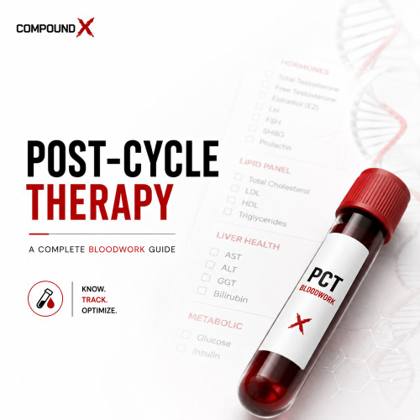
Bloodwork panels discussed in recovery-monitoring research commonly include:
- Total and free testosterone — the primary marker of endogenous production
- LH and FSH — pituitary signals that indicate whether the HPTA axis itself is active
- Estradiol (E2) — relevant because testosterone aromatizes to estrogen
- SHBG — affects how much testosterone is biologically available versus bound
- Lipid panel — several SARMs and AAS affect HDL/LDL cholesterol
- Liver enzymes (ALT/AST) — relevant given the liver-enzyme signals reported for compounds like RAD-140
- Hematocrit — androgen use can affect red blood cell production
This panel is a starting point for a conversation with a physician, not a self-diagnostic tool.
FAQ
Is PCT necessary after every cycle?
That depends on the specific compound, dose and duration — questions that require individualized bloodwork and physician input rather than a blanket answer. This guide explains the underlying concepts, not a personal recommendation.
What's the difference between clomiphene and enclomiphene?
Clomiphene is a mixture of two isomers (enclomiphene and zuclomiphene); enclomiphene is the isolated isomer generally considered responsible for clomiphene's estrogen-receptor-blocking, LH/FSH-boosting effect, with the other isomer linked to a longer half-life and different side-effect discussion in the literature.
How soon after a cycle should bloodwork be checked?
Timing depends heavily on the half-life of the specific compound used, which varies significantly across the compounds discussed on this site. This is a question for a physician familiar with the specific substance and timeline, not a fixed universal number.
References
This guide describes general HPTA endocrinology and SERM pharmacology as established in reproductive endocrinology literature. It is educational content, not medical advice, and does not cite a single primary trial because it covers general physiological mechanisms rather than one compound's trial data.