Ranking Methodology
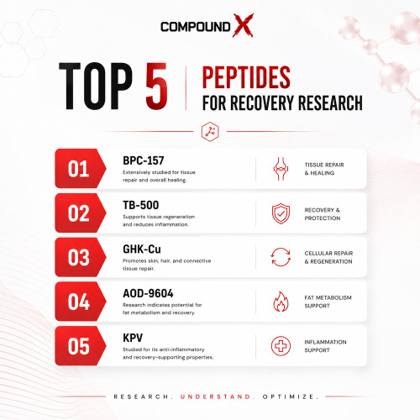
This list ranks the five peptides most frequently discussed in recovery and tissue-repair research contexts on this site, ordered by how directly their studied mechanism relates to recovery specifically, with an honest note on the strength of evidence behind each.
The Ranking
1
BPC-157
Most-cited tissue-repair peptide — animal data only
Studied in rodent models of tendon, ligament and gut-lining injury for promoting angiogenesis and modulating growth-factor signaling. The most frequently referenced recovery peptide in research communities, but the FDA's own 2023 assessment states it "lacks sufficient safety data and has not been shown to be safe or effective in humans."
2
TB-500
Actin-regulation mechanism, distinct from BPC-157
A fragment of Thymosin Beta-4, studied for influencing cell migration, angiogenesis and the formation of new blood vessels and muscle fibers. Frequently studied alongside BPC-157 due to a complementary (not identical) proposed mechanism.
3
GHK-Cu (Copper Peptide)
Decades of topical cosmetic use history
Studied for activating gene-expression pathways tied to collagen and elastin synthesis in connective tissue. Has the longest real-world (topical) usage track record of any peptide on this list, though systemic/injectable research use hasn't been through large controlled human trials.
4
Thymosin Alpha-1
Immune-modulation angle on recovery
A thymic peptide studied primarily for immune-system modulation, which intersects with recovery research through its proposed role in reducing inflammation and supporting immune resilience during physical stress — a less direct tissue-repair mechanism than BPC-157 or TB-500, but a real research angle.
5
KPV
Anti-inflammatory tripeptide fragment
A tripeptide fragment of alpha-MSH studied for anti-inflammatory signaling, including in gut-inflammation models — a smaller, more narrowly-studied research footprint than the peptides above it on this list, but a genuine part of the inflammation/recovery research conversation.
The Takeaway
Recovery-peptide research is still overwhelmingly preclinical
Every compound on this list has a real, active research interest behind it — but none has completed human clinical trials establishing safety or efficacy for a recovery indication. The honest starting point for any of these is understanding that "widely discussed" and "clinically proven" are not the same thing here.
FAQ
Is BPC-157 or TB-500 better for recovery research?
They're usually studied together rather than as alternatives, since they act through different proposed mechanisms — angiogenesis/growth-factor signaling (BPC-157) vs actin-regulated cell migration (TB-500).
Are any of these peptides FDA-approved?
No. None of the five is FDA-approved for a recovery or tissue-repair indication. All are sold labeled for laboratory research use only.
Which has the most human trial data?
None of the five has completed a controlled human trial specifically for a recovery indication. GHK-Cu has the longest real-world usage history, but that's from topical cosmetic use, not controlled recovery-research trials.
References
FDA Category 2 Bulks List assessment for BPC-157, September 2023. TB-500/Thymosin Beta-4 actin-regulation mechanism literature. GHK-Cu gene-expression and tissue-remodeling research. Thymosin Alpha-1 immune-modulation research literature.