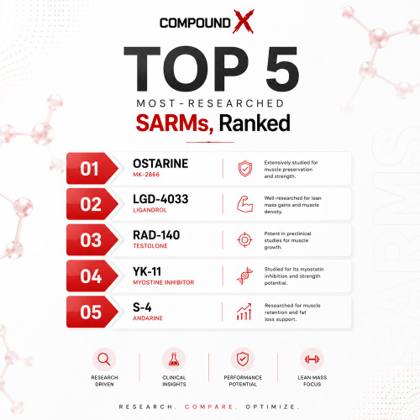
Ranking Methodology
This ranking is based strictly on one criterion: the existence and quality of published human clinical trial data for each compound, drawn from the primary sources cited throughout this site. It is not a ranking of sales volume, forum popularity, or subjective effectiveness claims — several SARMs with large online followings simply don't have meaningful human trial data to rank on, and that's reflected honestly below.
The Ranking
1
LGD-4033 (Ligandrol)
76-man RCT, dose-response confirmed
The Basaria et al. 2013 trial is the most rigorous human SARM study on this list: randomized, double-blind, placebo-controlled, with a clear dose-dependent lean mass result (+1.21kg at 1.0mg/day over 21 days) in healthy young men — the population most relevant to how it's actually discussed in research communities.
2
MK-677 (Ibutamoren)
2-year RCT, n=65 — longest trial on this list
Not technically a SARM (it's a ghrelin-receptor agonist, not an androgen receptor compound), but commercially grouped here. The Nass et al. 2008 trial is the longest, most rigorous human study of any compound covered on this site.
3
Ostarine (Enobosarm)
Reached Phase 3 human trials
Progressed furthest through the actual drug-development pipeline of any compound here — Phase 2 and Phase 3 (POWER) trials in cancer cachexia. Its Phase 3 trials ultimately failed their primary endpoints, but the sheer volume of regulated human testing outranks compounds with no trials at all.
4
RAD-140 (Testolone)
Phase 1 oncology trial, real human safety data
A genuine Phase 1 trial exists (in AR+/HER2- metastatic breast cancer patients), giving it real human pharmacokinetic and safety data — but the trial measured tumor response, not the lean-mass outcomes most research communities associate with it.
5
Cardarine (GW-501516)
Real Phase 1/2 trials — discontinued, not abandoned quietly
Not a SARM mechanistically (it's a PPARδ agonist), but it earns a spot for genuine, documented human trial history under GlaxoSmithKline before development was discontinued in 2007 due to rodent carcinogenicity findings — a well-documented outcome, not a mystery.
Honorable Mentions — Thin Research Footprint
S4 (Andarine), SR-9009 (Stenabolic), YK-11, ACP-105 and RAD-150 are all frequently discussed in the same research circles, but none has a completed human trial establishing safety or efficacy for its commonly-cited use case. SR-9009 in particular has a documented oral bioavailability problem (research doses were delivered via injection, not the oral capsules typically sold). These compounds aren't included in the ranked list above because there isn't meaningful human trial evidence to rank them against the top 5.
The Takeaway
"Most researched" and "most popular" are different lists
Several of the SARMs with the largest online followings (YK-11, S4, RAD-150) have essentially no human trial data. The compounds that actually made it into regulated human trials — LGD-4033, MK-677, Ostarine, RAD-140, Cardarine — are worth understanding on their own trial-specific merits, not by online popularity.
FAQ
Why is MK-677 on a list of "most-researched SARMs" if it's not actually a SARM?
Because it's commercially sold and categorized alongside SARMs on most vendor sites, including this one, despite its different growth-hormone-secretagogue mechanism. We've flagged that distinction clearly rather than omit a compound most readers expect to see.
Why isn't YK-11 or S4 on this list?
Because neither has a completed human clinical trial establishing safety or efficacy. This ranking is specifically about trial-backed evidence, not popularity or anecdotal use.
Does being "most researched" mean a SARM is safe?
No. Even the top-ranked compounds here are not FDA-approved for general use, and several (RAD-140, Cardarine) showed significant safety signals in their own trial data.
References
Basaria S, et al. Journals of Gerontology: Series A. 2013;68(1):87-95. Nass R, et al. Annals of Internal Medicine. 2008;149(9):601-611. Dalton JT, et al. J Cachexia Sarcopenia Muscle. 2011; POWER trials (Phase 3). First-in-human Phase 1 RAD140 oncology trial. GW501516 development history, GlaxoSmithKline.