Quick Overview
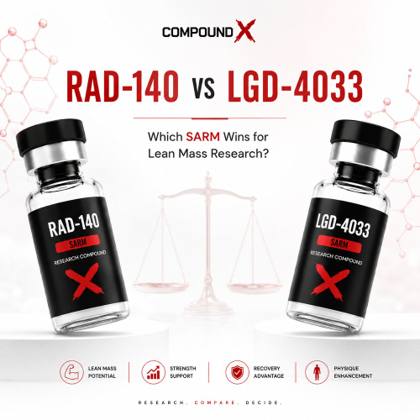
RAD-140 (Testolone) and LGD-4033 (Ligandrol) are both nonsteroidal SARMs frequently compared in research communities. What sets this comparison apart from most SARM match-ups is that both compounds have real, published human trial data — but the trials were designed to answer completely different questions, which matters more than most side-by-side guides let on.
RAD-140 (Testolone)
Developed by Radius Health. Advanced into oncology trials for AR+/HER2- breast cancer, now studied as Vosilasarm. Human data comes from a Phase 1 cancer trial.
LGD-4033 (Ligandrol)
Developed by Ligand Pharmaceuticals. Studied directly in a 76-man, placebo-controlled RCT measuring lean body mass in healthy young men.
Mechanism Compared
Both bind the androgen receptor (AR) with high affinity and are designed for tissue-selective anabolic activity — targeting muscle and bone while reducing stimulation of the prostate and other reproductive tissue relative to testosterone. The core mechanism is similar; what differs is which body of evidence backs each compound's real-world receptor behavior. RAD-140 also showed AR-activation activity relevant to slowing estrogen-driven tumor growth in AR-positive breast cancer models — a distinct research application LGD-4033 has not been studied for.
The Trial Data, Side by Side
LGD-4033 — Basaria et al., 2013
76 healthy young men, randomized, double-blind, placebo-controlled, dosed once daily for 21 days at 0.1mg, 0.3mg or 1.0mg. Result: dose-dependent lean mass gain up to +1.21kg at the highest dose, alongside suppressed SHBG, total testosterone and HDL cholesterol.
RAD-140 — Phase 1 Oncology Trial
Postmenopausal women with advanced ER+/HER2- metastatic breast cancer. At the 100mg/day maximum tolerated dose: 18.2% clinical benefit rate at 24 weeks, one confirmed partial response. Grade 3/4 adverse events in up to 72.7% of participants at higher doses.
The practical takeaway: LGD-4033's trial is the more directly relevant one if the question is "what happens to lean mass in a healthy person" — that's literally what it measured. RAD-140's trial answers a different question entirely (tumor response in an oncology population), and its lean-mass reputation in research communities is extrapolated from preclinical rodent data, not measured in its own human trial.
Dosing Guide
What each trial actually tested
| Compound | Dose Tested | Trial Population |
|---|
| LGD-4033 | 0.1 / 0.3 / 1.0 mg/day, 21 days | 76 healthy young men |
| RAD-140 | Up to 100 mg/day (MTD) | Postmenopausal women, advanced breast cancer |
Compound X does not provide dosing recommendations. Both compounds are sold for laboratory research use only and are not intended for human consumption.
Side Effects Compared
LGD-4033's 21-day trial found dose-dependent suppression of SHBG, total testosterone and HDL cholesterol — meaningful even over a short window, though the trial reported it was otherwise well tolerated in that period. RAD-140's oncology trial reported a notably higher-severity profile: elevated liver enzymes, hyperbilirubinemia, hypophosphatemia, vomiting and weight loss, with severe (Grade 3/4) events in up to 72.7% of participants at higher doses — though that population was already affected by advanced cancer and prior treatment, which likely inflates the apparent severity relative to a healthy population.
The Verdict
Which has the stronger evidence base for its specific claim?
For lean-mass research specifically, LGD-4033 has the more directly applicable human data — a real RCT in healthy men measuring exactly that outcome. RAD-140 has real human data too, but it answers an oncology question, not a body-composition one. Neither is FDA-approved, both are WADA-banned, and neither has an established human dosage outside its respective trial.
FAQ
Which has more human trial data, RAD-140 or LGD-4033?
Both have real, published human trial data — LGD-4033 from a 76-man RCT measuring lean body mass, RAD-140 from a Phase 1 oncology trial measuring tumor response. They're not directly comparable outcomes.
Are RAD-140 and LGD-4033 legal?
Neither is FDA-approved. Both are sold labeled "for research use only, not for human consumption" and are banned under WADA's SARMs category for competitive athletes.
Which SARM has worse side effects?
RAD-140's oncology trial reported a higher rate of severe adverse events, though in a cancer population already affected by disease and prior treatment. LGD-4033's healthy-population trial reported hormonal and lipid suppression but was otherwise described as well tolerated over its 21-day window.
References
Basaria S, Collins L, Dillon EL, et al. Journals of Gerontology: Series A. 2013;68(1):87-95. First-in-human Phase 1 study of RAD140 in ER+/HER2- metastatic breast cancer. World Anti-Doping Agency Prohibited List, SARMs category.