Quick Overview
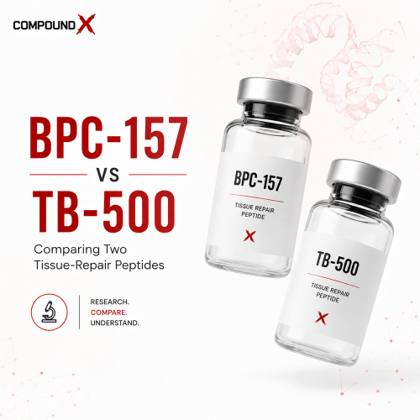
BPC-157 and TB-500 are the two most-discussed peptides in tissue-repair research communities, and they're frequently mentioned in the same sentence — sometimes as alternatives, sometimes as a stack. That framing undersells an important point: both compounds' research bases are dominated by animal studies, not human trials, and they work through different proposed mechanisms.
BPC-157
A synthetic peptide fragment based on a sequence identified in human gastric juice. Studied mainly in rodent models of tendon, ligament and gut-lining injury.
TB-500
A synthetic version of a fragment of Thymosin Beta-4, a naturally occurring actin-regulating protein. Studied in cell-migration and wound-healing contexts.
Mechanism Compared
BPC-157 has been investigated in preclinical models for promoting angiogenesis (new blood vessel formation) and modulating growth-factor signaling pathways relevant to tissue repair, primarily in rodent models of tendon, ligament and gastrointestinal injury. TB-500 works through a different proposed pathway — as a fragment of Thymosin Beta-4, it's studied for influencing cell migration and the formation of new blood vessels and muscle fibers via actin regulation, mechanisms most commonly cited in wound-healing and cardiac-repair research. They are not mechanistically interchangeable, which is part of why they're often studied together rather than as either/or options.
What the Evidence Actually Shows
This is the most important point in this comparison: neither peptide has a completed controlled human trial establishing safety or efficacy. For BPC-157, the FDA's own September 2023 risk assessment states it "lacks sufficient safety data and has not been shown to be safe or effective in humans" — a direct regulatory conclusion. TB-500's human safety data is similarly limited, with reported concerns (injection-site reactions, transient fatigue) drawn from anecdotal reports rather than controlled trials. The large volume of "research" cited for both compounds online is overwhelmingly rodent and in-vitro work.
Dosing Guide
Why there's no dosing table here
Neither BPC-157 nor TB-500 has a completed controlled human trial establishing a dose-response relationship. Animal studies use doses scaled to rodent body weight, which do not translate into a validated human protocol for either compound.
Compound X does not provide dosing recommendations. Both peptides are sold for laboratory research use only and are not intended for human consumption.
Regulatory Status
BPC-157 has the more clearly documented regulatory position of the two: FDA Category 2 (bulk substances that may present significant safety risks in compounding, as of September 2023), ineligible for 503B compounding, and on WADA's Prohibited List since 2022 under Section S0 (Non-Approved Substances). TB-500 does not have as explicit a public FDA risk-category statement, but it shares the same fundamental status: not approved as a drug, food, or dietary supplement ingredient in the US, and sold strictly as a research chemical.
The Verdict
Neither is more "proven" than the other
Both BPC-157 and TB-500 sit in the same evidentiary category: extensive preclinical interest, minimal-to-no controlled human data. Choosing between them based on claims of superior human safety or efficacy isn't supported by the current published literature for either compound — the honest answer is that both need far more human research before those claims could be verified.
FAQ
Can BPC-157 and TB-500 be studied together?
They're frequently discussed together in research contexts because they act through different proposed mechanisms (angiogenesis/growth-factor signaling vs actin-regulated cell migration), but combined-use human data doesn't exist any more than single-compound human data does.
Which peptide has better human safety data?
Neither has completed a controlled human trial. BPC-157's regulatory status is more explicitly documented via the FDA's 2023 Category 2 assessment; TB-500's human data is similarly limited but less formally categorized.
Is either BPC-157 or TB-500 legal to buy in the US?
Both are sold labeled "for research use only, not for human consumption" and are not approved as drugs, foods, or dietary supplements. BPC-157 is explicitly WADA-banned.
References
FDA Category 2 Bulks List assessment for BPC-157, September 2023. World Anti-Doping Agency Prohibited List, Section S0, 2022 addition. TB-500/Thymosin Beta-4 mechanism research as characterized in actin-regulation and wound-healing preclinical literature.