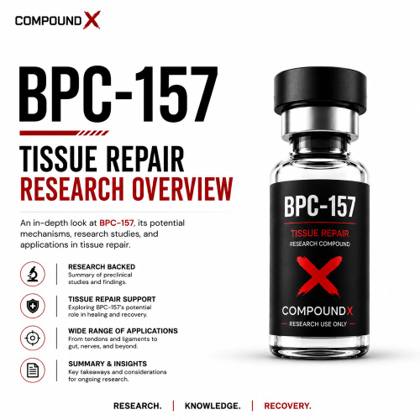
What Is BPC-157?
BPC-157 is a synthetic peptide fragment based on a sequence identified in human gastric juice. It has become one of the most widely discussed peptides in online research communities, primarily for its investigation in animal models of tissue repair — tendons, ligaments, muscle and gut-lining injury.
Mechanism of Action
Preclinical studies have investigated BPC-157 for promoting angiogenesis (new blood vessel formation) and modulating growth-factor signaling pathways involved in tissue repair, primarily in rodent models of tendon, ligament and gastrointestinal injury. The specific molecular pathways remain an active area of preclinical research rather than settled human pharmacology.
What the Evidence Actually Shows
This is the single most important thing to understand about BPC-157: the evidence base is almost entirely preclinical. The FDA's own September 2023 risk assessment stated that BPC-157 "lacks sufficient safety data and has not been shown to be safe or effective in humans." That is a direct regulatory-agency conclusion, not editorializing. The large volume of tissue-repair studies referenced across the wider research community are rodent and in-vitro studies, not completed controlled human trials.
Studied Benefits (Animal Models)
Every item below reflects animal or in-vitro research, not confirmed human outcomes.
🦵
Tendon/Ligament Models
The most frequently cited category of BPC-157 animal research, examining healing markers after induced injury.
🩹
Gastric/Gut-Lining Models
Reflects BPC-157's origin as a gastric-juice-derived peptide fragment, studied in rodent GI injury models.
🩸
Angiogenesis Research
Investigated preclinically for promoting new blood vessel formation relevant to tissue repair.
🔬
Active Research Interest
One of the most frequently cited peptides in current preclinical tissue-repair literature.
Dosing Guide
Why there is no human dosing table here
Unlike RAD-140, LGD-4033 or MK-677, BPC-157 does not have a completed controlled human trial establishing a dose-response relationship. The FDA has explicitly stated it "lacks sufficient safety data and has not been shown to be safe or effective in humans." Animal studies use doses scaled to rodent body weight (typically reported in µg/kg), which do not translate into a validated human protocol.
Compound X does not provide dosing recommendations for BPC-157 or any compound. It is sold for laboratory research use only and is not intended for human consumption.
FDA & WADA Status
In September 2023, the FDA placed BPC-157 in Category 2 — bulk substances that may present significant safety risks if used in compounding — citing immunogenicity concerns, peptide-related impurities and complexities in characterizing the active ingredient. It is ineligible for 503B compounding, and the FDA and USADA have both stated there is no legal basis for BPC-157 as a drug, food or dietary supplement ingredient in the US. Separately, the World Anti-Doping Agency added BPC-157 to its Prohibited List in 2022 under Section S0 (Non-Approved Substances), banning it in competitive sport at all times. It is also on the Department of Defense's Prohibited Dietary Supplement Ingredients List.
FAQ
Has BPC-157 been tested in humans?
Not in a completed controlled trial that has established safety or efficacy. The FDA's September 2023 assessment explicitly states it "lacks sufficient safety data and has not been shown to be safe or effective in humans."
Is BPC-157 legal to buy in the US?
It is not approved as a drug, food, or dietary supplement ingredient. It is sold by research-chemical vendors labeled "for laboratory research use only, not for human consumption," and is banned under WADA rules for competitive athletes.
Why is BPC-157 so widely discussed if the human evidence is limited?
Its large body of animal-model tissue-repair research and gastric-juice-derived origin story have made it popular in online research communities, but that popularity reflects preclinical interest rather than confirmed human clinical results.
References
FDA Category 2 Bulks List assessment for BPC-157, September 2023 (fda.gov). World Anti-Doping Agency Prohibited List, Section S0 Non-Approved Substances, 2022 addition. US Anti-Doping Agency (USADA) and Department of Defense Prohibited Dietary Supplement Ingredients List guidance on BPC-157.