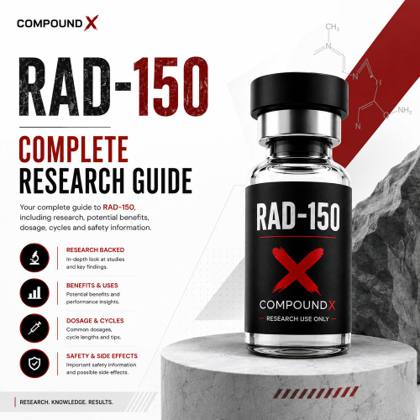
What Is RAD-150?
RAD-150 is described in the research-chemical marketplace as a long-acting nonsteroidal selective androgen receptor modulator (SARM), related in naming convention to RAD-140 but with a substantially smaller and less independently verified research record.
Mechanism of Action
RAD-150 is marketed as sharing RAD-140's androgen-receptor-selective mechanism with a longer duration of action, though this claim is based primarily on vendor and research-community reporting rather than an independently published pharmacokinetic dataset comparable to RAD-140's.
Studied Benefits
These are effects RAD-150 has been studied for in available preclinical and early research — not claims about guaranteed outcomes.
🧬
Emerging SARM Research
RAD-150 is a newer addition to the SARM research-chemical market, and independently published, peer-reviewed data specific to RAD-150 (as opposed to RAD-140) is very limited at this time.
⚡
Comparative Research Context
Where RAD-150 is discussed in research contexts, it is typically compared against the better-established RAD-140 dataset rather than supported by its own dedicated clinical or preclinical trial literature.
Dosing Guide
What the research shows
No dosage of any kind has been clinically validated for RAD-150 in humans. Any protocols circulating in research-community sources are anecdotal and not supported by peer-reviewed trial data.
Compound X does not provide dosing recommendations. RAD-150 is sold for laboratory research use only and is not intended for human consumption.
Reported Side Effects
Because independently published research on RAD-150 specifically is minimal, its human safety profile is essentially uncharacterized. It has never been evaluated in human clinical trials, is not FDA-approved, and no meaningful independent human safety data exists.
FAQ
Is RAD-150 FDA-approved?
No. RAD-150 is not FDA-approved for any indication and is sold strictly as a research chemical, not a medication or dietary supplement.
What is RAD-150 commonly studied for?
Emerging SARM Research — RAD-150 is a newer addition to the SARM research-chemical market, and independently published, peer-reviewed data specific to RAD-150 (as opposed to RAD-140) is very limited at this time.
Is RAD-150 legal to buy in the US?
In the US, UK, Canada and Australia, RAD-150 is generally sold labeled "for research use only, not for human consumption." It is not approved as a dietary supplement or medication in any of these countries.
References
Independently published data specific to RAD-150 is limited; researchers typically cross-reference the broader SARM structure-activity literature indexed on PubMed under "selective androgen receptor modulator."